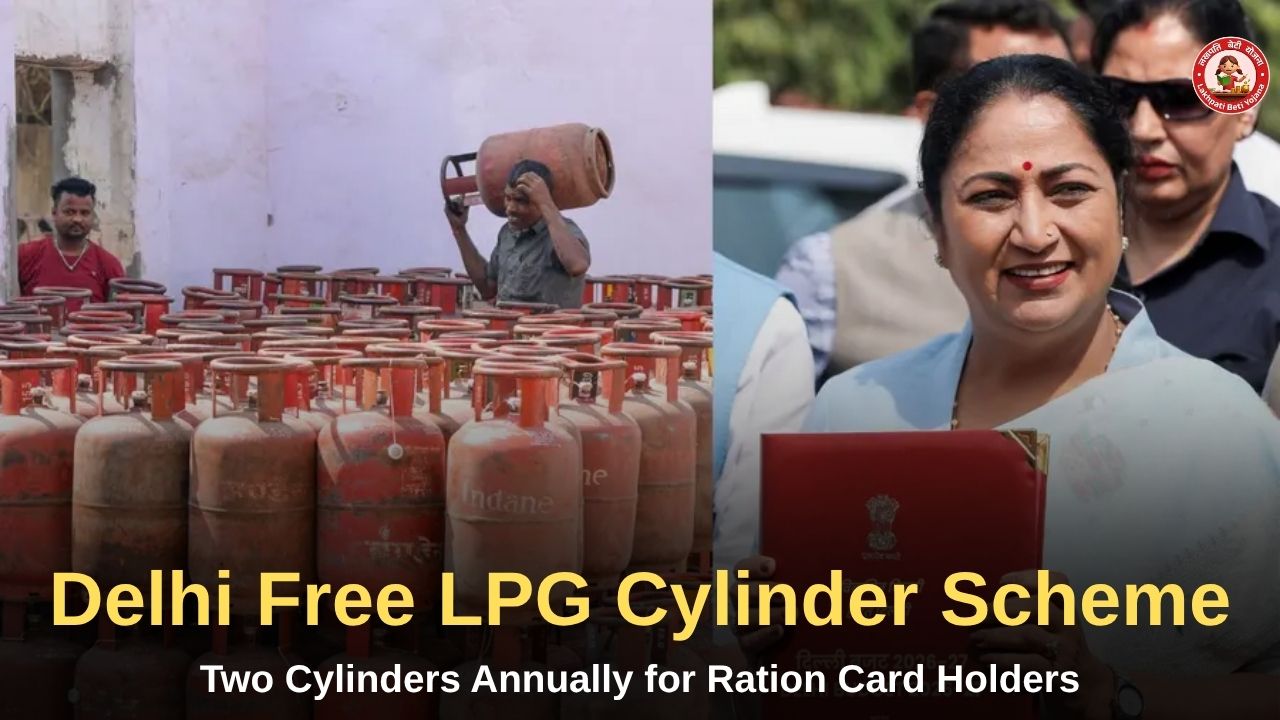
Delhi Free LPG Cylinder Scheme: The Delhi government has approved and rolled out a scheme to provide two free LPG cylinders annually to ration cards–holding families, aligning the benefit with major festivals—Holi and Diwali. The initiative, formally launched by Droupadi Murmu, will be implemented through Direct Benefit Transfer (DBT), ensuring that the equivalent cost of LPG cylinders is credited directly into Aadhaar-linked bank accounts of beneficiaries.
Announced earlier by Chief Minister Rekha Gupta, the scheme is expected to cover approximately 1.55 million families and is backed by a ₹260 crore allocation in the 2026–27 Delhi Budget.
Key Takeaways: Delhi Free LPG Cylinder Scheme
- Two free LPG cylinders annually for ration card holders
- Benefits provided during Holi and Diwali
- Scheme launched in 2026
- Implemented via Direct Benefit Transfer (DBT)
- Amount credited to Aadhaar-linked bank accounts
- Covers approximately 1.55 million families
- ₹260 crore allocated in Delhi Budget 2026–27
- No application required for beneficiaries
Scheme Launch and Implementation Framework
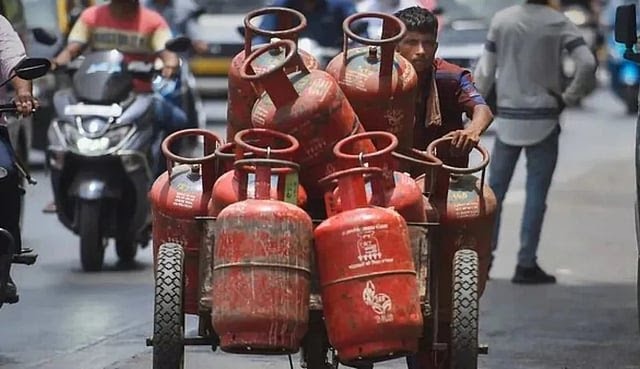
The Delhi government has initiated the Delhi Free LPG Cylinder Scheme following cabinet approval, marking a significant welfare measure aimed at supporting households with essential cooking fuel. The scheme was formally launched by President Droupadi Murmu, establishing its official rollout.
Chief Minister Rekha Gupta had earlier announced on February 4 that all ration card–holding families in Delhi would receive financial assistance equivalent to the cost of two LPG cylinders annually. The implementation aligns with the government’s stated approach of delivering targeted financial support through structured welfare initiatives.
The benefit is scheduled to be disbursed on two key occasions—Holi and Diwali—ensuring that households receive assistance during periods of increased expenditure.
Direct Benefit Transfer Mechanism
The scheme is designed to function through a Direct Benefit Transfer (DBT) system. Instead of distributing physical LPG cylinders, the government credits the equivalent monetary value directly to beneficiaries.
- The amount corresponds to the prevailing market price of one LPG cylinder
- Funds are transferred to the Aadhaar-linked bank account
- The account must belong to the head of the family listed on the ration card
This approach is intended to ensure transparency, reduce administrative complexities, and facilitate direct financial access for eligible households.
Beneficiary Coverage and Eligibility
The scheme is expected to benefit approximately 1.55 million ration cards–holding families across Delhi. Eligibility is defined clearly:
- Only families with valid ration cards issued in Delhi are included
- The head of the household must have an Aadhaar-linked bank account
- No separate application process is required
This automatic inclusion mechanism simplifies access and ensures that beneficiaries receive support without additional procedural steps.
Budget Allocation and Financial Backing
The Delhi government has allocated ₹260 crore in the 2026–27 Budget to implement the scheme. This allocation forms part of a broader financial plan presented by Chief Minister Rekha Gupta.
Also Read: PM Surya Ghar Muft Bijli Yojana – सोलर सब्सिडी से 1 करोड़ घरों को मुफ्त बिजली का लक्ष्य
The total budget for the fiscal year stands at ₹1,03,700 crore, making it one of the largest budgets presented for the national capital. The government has described it as a “Green Budget”, with a significant portion dedicated to environmental and sustainability initiatives.
Also Read: Delhi Tightens LPG Supply Norms, Pushes PNG Transition Nationwide
Despite a strong focus on infrastructure and environmental measures, the inclusion of the LPG cylinder scheme highlights the continuation of welfare-oriented spending within the broader fiscal framework.
Position Within the ‘Green Budget’ Framework
The 2026–27 budget allocates 21 per cent of its total outlay to environment-related initiatives. Key components include:
- Increased environment budget to ₹822 crore (from ₹505 crore)
- Collaboration with the World Bank for pollution control systems
- Development of biogas plants and e-waste disposal units
- ₹50 crore allocation for pollution testing centres
While these measures emphasize sustainability and pollution control, the LPG scheme complements the broader policy direction by supporting cleaner cooking fuel access for households.
Infrastructure and Development Priorities
Alongside welfare measures, the budget emphasizes large-scale infrastructure development. Key allocations include:
| Sector | Allocation | Purpose |
| Urban development & housing | ₹7,800 crore | City expansion |
| Public Works Department | ₹5,921 crore | Roads and infrastructure |
| MCD funding | ₹11,666 crore | Civic services |
| Transport budget | ₹8,374 crore | Mobility improvements |
Major infrastructure projects announced include:
- Upgradation of 750 km of roads (₹1,392 crore)
- Expansion of the Barapullah corridor (₹210 crore)
- Development of Trans-Yamuna areas (₹300 crore)
The budget also outlines targets for electric mobility, including increasing EV buses from 4,300 to 7,500.
Social Welfare and Additional Schemes
Beyond the LPG initiative, the government has announced several welfare and social schemes:
- Rani Haat: ₹10 crore allocation for marketplaces for skilled women
- Delhi Lakhpati Bitiya Yojana: ₹128 crore allocation providing ₹1.2 lakh from birth to graduation
- Distribution of sanitary napkins in schools (2.5 crore units annually)
- Free cycles for Class 9 girls and laptops for Class 10 merit students
The education sector receives an allocation of around ₹19,000 crore, with continued expansion of smart classrooms and medical facilities in government schools.
Economic Indicators and Policy Approach
The budget outlines projected economic growth indicators:
- Per capita income expected to rise from ₹5 lakh to ₹5.3 lakh by 2027
- Delhi’s GDP share projected to increase from 3.67 per cent to 3.72 per cent
The government has framed its infrastructure strategy around a “4S model”:
- Speed
- Skill
- Strength
- Scale
Additionally, the budget emphasizes a “triple-engine government” framework, referring to alignment between central, state, and local governance structures.
Policy Direction and Welfare Integration
The Delhi Free LPG Cylinder Scheme reflects the government’s integration of welfare measures within a broader fiscal and policy framework. While the budget emphasizes infrastructure, environmental initiatives, and economic growth, targeted schemes such as this aim to address immediate household needs.
The use of DBT ensures that benefits are delivered directly and efficiently, aligning with administrative practices focused on transparency and accountability. As part of the 2026–27 budget, the scheme represents a structured approach to combining social welfare with broader developmental priorities in the national capital.
Spiritual Perspective on Responsible Welfare
Public welfare initiatives often highlight the importance of supporting society in practical ways, especially during significant occasions like festivals. Such measures reflect a broader value system rooted in care, balance, and responsibility. In a spiritual context, true welfare is not limited to material support but also includes guidance that leads individuals toward a disciplined and meaningful life.
According to the teachings of Tatvdarshi Saint Rampal Ji Maharaj, true Knowledge emphasizes righteous living, compassion, and responsible use of resources. He explains that while physical support addresses immediate needs, spiritual awareness helps individuals understand the purpose of life and make balanced decisions. His Knowledge encourages a harmonious approach where both material well-being and spiritual growth coexist, guiding society toward stability and inner clarity.
For more information visit our
Website:www.jagatgururampalji.org
YouTube: Sant Rampal Ji Maharaj
Facebook: Spiritual Leader Saint Rampal Ji
X (Twitter): @SaintRampalJiM
FAQs on Delhi Free LPG Cylinder Scheme
1. What is the Delhi Free LPG Cylinder Scheme?
It provides two free LPG cylinders annually to ration cards–holding families in Delhi.
2. How are benefits delivered under the scheme?
Through Direct Benefit Transfer to Aadhaar-linked bank accounts.
3. Who launched the scheme?
The scheme was formally launched by President Droupadi Murmu.
4. How many families will benefit?
Approximately 1.55 million ration cards–holding families.
5. Is application required for the scheme?
No, eligible beneficiaries are included automatically.